

Third party IT maintenance providers sell coverage in countries where they often have no staff of their own. The contract promises an engineer at the customer’s site within a set response time, so somebody has to find, vet, brief and manage that engineer, in a country the TPM’s operations team may never have visited. How a provider does that decides whether the contract works in practice.
This post looks at the usual ways TPM providers source field engineers across many countries, what each approach costs you in management time, and what to look for in a field partner if you go that route.
Three ways to cover a country
Most third party maintenance providers use a mix of three models, picking per country based on volume and risk.
Your own employed engineers
Salaried engineers make sense where you have steady volume: a home market, or a city with enough customer sites to keep someone busy. You control training, quality and availability. The cost is fixed whether calls come in or not, and one engineer can’t cover a whole country at a 4-hour response.
Freelancers you contract directly
Building your own list of freelance engineers is flexible and can work well in a few countries. It also means your team does the recruiting, the screening, the right-to-work checks, the invoicing in local currency and the scramble when your one contact in a city is on holiday. Across many countries, that admin grows faster than the call volume.
A field services partner
A partner supplies engineers on demand, per ticket, by day rate or as resident engineers, and takes on the sourcing, screening, backups and reporting. You give up some direct control in exchange for one contract, one process and one invoice covering many countries.
| Model | Best fit | Main drawback |
|---|---|---|
| Employed engineers | High, steady volume in one area | Fixed cost, limited geographic reach |
| Direct freelancers | A few countries with occasional calls | Recruiting, vetting and backup all fall on you |
| Field services partner | Many countries, uneven volume | Quality depends on choosing the right partner |
A typical case: adding a country to a contract
Say you’re a TPM vendor that has just won a hardware maintenance renewal. Most of the customer’s sites are in your home market, where you have employed engineers, but the new schedule adds a data centre in Germany, two offices in Italy and a warehouse in Sweden. The contract sells next business day for the offices and the warehouse, and a 4-hour response for the data centre.
Hiring in three new countries for a handful of sites makes no sense. A freelancer list might work for the offices, but the 4-hour tier at the data centre needs more than one name you can call. So the sensible move is a field partner for all three countries, with your own NOC staying in charge of diagnosis.
Before the contract goes live, you send the partner the exact site addresses, the device list with serials, the tiers sold per site and your ticket and report templates. You confirm data centre access rules: who has to be on the access list, how far in advance, and what ID the engineer needs. You agree where parts will ship from and who receives them. Then you raise one planned ticket per country, a site familiarisation visit or a low-risk swap, so the first engineer to walk into the data centre isn’t doing it during a priority fault. By the time the first real failure comes in, the ticket format, the access process and the report have all been tested once.

How third party IT maintenance providers vet engineers
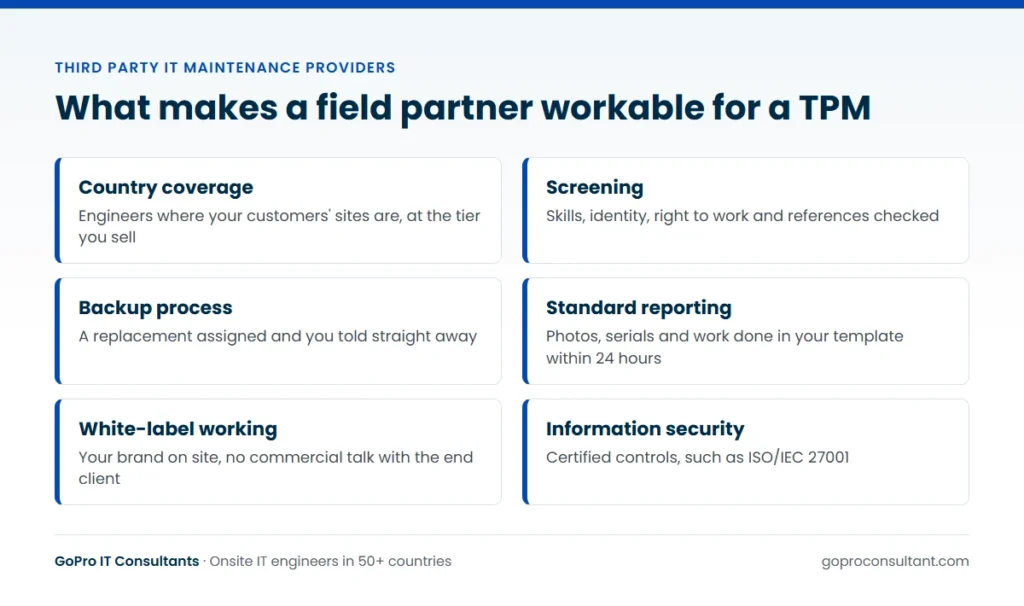
Whoever does the sourcing, the vetting needs to cover the same ground. The engineer is walking into your customer’s data centre or office under your contract, so the checks matter as much as the skills.
- Skills: relevant hardware and network experience, checked against the type of work, not just a CV.
- Identity: photo ID that matches the name going on data centre access lists.
- Right to work: confirmed for the country the engineer is working in.
- References: from previous field work, ideally similar jobs.
- Insurance: public liability and professional indemnity cover in place for the work.
At GoPro IT Consultants, engineers are screened for skills, identity, right to work and references, and every engineer is briefed before each job. The briefing is the part people underestimate. A capable engineer with a poor briefing will still lose time on site.
Keeping quality consistent across countries
The hardest part of running onsite work in many countries isn’t finding engineers. It’s getting the same result in Milan as in Melbourne. Three things do most of the work:
- One ticket format. Site, device, serial, task as steps, access reference, parts and remote contact, in the same order every time.
- One report format. Photos, serial numbers, work done and anything outstanding, in a template your customers recognise.
- One escalation route. A named contact who picks up when an engineer finds something the ticket didn’t expect.
Every visit we deliver gets a site visit report within 24 hours, and engineers can use the partner’s own report template. That way your customer sees one consistent document whichever country the work happened in. The fixed ticket format pays off at briefing time too. When every ticket arrives in the same shape, briefing an engineer takes minutes and less gets lost in translation, which matters when the engineer and your NOC don’t share a first language.
Who does what on a partner-delivered ticket
Three organisations touch every partner-delivered call, plus the customer’s own site staff. Most friction comes from overlaps nobody wrote down, so it’s worth making the split explicit in your onboarding pack.
| Party | Owns |
|---|---|
| TPM provider (you) | Customer contract, fault diagnosis, ticket content, parts ordering, customer updates, closure |
| Field partner | Engineer sourcing and screening, dispatch, briefing, backups, site visit report |
| Field engineer | Attending in the window, following the task steps, photos and serials, flagging anything unexpected |
| Parts vendor or depot | Shipping the right part to the right address in time, and collecting the defective one |
| Customer site contact | Access, escorts where required, confirming the system is back in use |
One line deserves particular care: who the engineer takes instructions from once on site. It should be your remote engineer, named on the ticket, not whoever on the customer’s side happens to be standing nearby. Anything outside the ticket’s scope goes back to you to approve.
Backups, absences and the call nobody can take
Any engineer can fall ill, get stuck in traffic or be on another job when a priority call lands. With a direct freelancer list, that’s your problem at the moment it happens. A partner should have a defined backup process. Ours is simple: if an engineer can’t attend, a backup is assigned and the partner is told straight away, so you can update your customer before they start chasing.
For sites with steady demand, a resident engineer on agreed hours can take the pressure off dispatch altogether, with holiday and sickness cover arranged through the same contract.
Parts logistics across borders
A fast engineer is no use if the part is still in a depot two countries away. For a TPM, parts planning is often the real limit on response in a new market, and it’s the part a field partner can’t solve for you. When we’re the field partner, parts are shipped by you or your vendor, and the engineer meets them on site.
Three things keep this workable. First, match stocking to the tier you’ve sold: a 4-hour commitment on a server usually means critical spares held in or near that country, not shipped on demand. Second, agree where parts are delivered. Sending them straight to the customer site works for offices with a reception desk; data centres often have their own goods-in rules and may refuse unannounced deliveries. Third, plan the return of defective parts, including the packaging and the courier booking, so the engineer isn’t left holding a failed drive with no instructions.
Cross-border shipments add customs time and paperwork, and that delay lands on your response clock rather than the courier’s. When a fix turns out to need a different part or a second visit, the engineer records what was found and what’s needed, and the return visit goes in as a new ticket. That keeps your SLA reporting honest about where the time went. For data centre work in particular, our smart hands and data centre support covers the hardware swaps and cabling once the part is on site.
Matching response tiers to geography
A common mistake is selling one response tier across a whole region. Engineer density varies a lot between a capital city and a provincial town, and the contract should reflect that. A sensible pattern is a 4-hour response in major cities, same business day for faults logged before a cut-off, next business day elsewhere, and scheduled visits for planned work. Our 4-hour tier covers major cities across the UK, Western Europe, the Gulf, Australia, Singapore and the USA.
Before you commit to a tier in a new country, send your partner the actual site addresses. That’s also the only way to get a sensible quote, because pricing depends on country and response tier. The global coverage page lists where our engineer network operates.
Common mistakes when onboarding a field partner
Partnerships between TPMs and field providers rarely fail on engineering skill. They fail on set-up. These are the slips worth avoiding in the first few weeks:
- Selling the tier before checking the address. The customer is promised 4-hour cover at a site that’s a long drive from the nearest engineer.
- Sending tickets in free text. Each one arrives in a different shape, and the briefing step slows down or misses the serial number.
- Leaving access to the night of the fault. The engineer is ready, but the data centre access list was never updated.
- No named remote contact. The engineer is on site with a question and nobody on your side picks up.
- Treating reports as optional. Without a report in your template, you can’t show the customer what was done, or prove the response time.
- Going live with a priority call. The first ticket a new partner sees is a severity one fault, with no dry run behind it.
Most of these are fixed by a short onboarding pack and one planned ticket per country before the contract’s first real call. Our field engineer dispatch service takes tickets in your format, and what to put in a break fix contract covers the contract terms that sit behind each call.
What to ask a prospective field partner
When you’re comparing third party maintenance field partners, these questions separate the organised ones quickly:
- Which countries can you cover, and at which response tier in each?
- How do you screen engineers, and what insurance is in place?
- What happens when the assigned engineer can’t attend?
- Can engineers work under our brand and use our report template?
- How do you handle a job that needs a part or a second visit?
- How do you protect our customers’ data and site information?
On the last point, a certification is easier to check than a promise. GoPro IT Consultants is certified to ISO/IEC 27001:2022 and registered with the ICO. On brand, our engineers work under the partner’s badge and never discuss commercial terms with the end client, which is how white-label IT services should work for a TPM.
Starting small with a pilot ticket
You don’t need to move a whole region to test a partner. Pick one country where your current cover is thin, send one real ticket and judge the result: how quickly it was acknowledged, whether the engineer arrived briefed, and whether the report was good enough to forward to your customer. We start every new relationship that way, with one pilot ticket and no minimum commitment. If you’re a TPM vendor looking for onsite cover, the partner page explains how to get started, and how onsite support fits a third-party data centre maintenance contract covers the contract side.
Frequently asked questions
Can a field partner cover only the countries where we have gaps?
Yes. Many TPM providers keep their own engineers in core markets and use a partner for the rest, country by country.
Who manages the engineer during the visit?
The partner briefs and dispatches the engineer, while your remote team stays on the phone for diagnosis and sign-off. The ticket should name who the engineer takes instructions from.
How are field partners usually paid?
Per ticket, by day rate, or as a monthly FTE for resident engineers. The rate depends on the country and the response tier you need.
Will the end customer know a partner did the work?
Not on white-label jobs. The engineer attends under your brand, uses your report template and passes commercial questions back to you.
Need engineers in a country you can't cover?
Our engineer network spans 50+ countries. Send one pilot ticket with no minimum commitment and judge the result.
Become a partner