

Third party data center maintenance contracts are sold on parts, expertise and response times, but they’re delivered by whoever turns up at the cabinet. For a TPM vendor, the onsite engineer is the part of the service the customer actually sees. For a data centre operator buying TPM, it’s the part most likely to go wrong if nobody has thought about it before the first fault.
This post looks at how onsite support fits inside a TPM contract: who does what, how a call flows from fault to fix, where parts and reporting sit, and what an operator should check about the engineers behind the contract.
The layers inside a TPM contract
Most data center third party maintenance agreements break down into the same four layers, whoever delivers each one:
- Remote support and diagnosis. The TPM’s support desk takes the call, reads the logs and decides what’s failed.
- Parts logistics. Spares held in depots or forward stocking locations, shipped to site against the diagnosis.
- Onsite engineering. Someone physically at the device to fit the part, run the checks and hand back to the remote team.
- Reporting. Evidence that the work was done, which parts went in and out, and what’s still open.
Many TPM vendors run the first two layers themselves and subcontract the third in some or all countries. That’s normal. Keeping salaried engineers in every city where a customer has a rack rarely makes sense, especially when a site might log only a handful of faults a year. The skill is in making the subcontracted layer look and behave like part of the TPM’s own service.
Matching response tiers to what onsite can deliver
The response tier in a TPM contract is a promise about the onsite layer, so it has to match what the field partner can actually provide at each location. A tier that works in a capital city may not be realistic at a site three hours from the nearest engineer.
| Response tier | Where it tends to fit |
|---|---|
| 4-hour response | Business-critical kit in major cities, with the part already on site or close by |
| Same business day | Faults logged before a cut-off, where a short delay is acceptable |
| Next business day | Redundant components, such as one PSU or one drive in a protected array |
| Scheduled visit | Planned swaps, firmware-related part changes and preventive work, including nights and weekends |
| Resident engineer | Large estates with steady volumes, covered for agreed hours |
Remember that response and repair aren’t the same thing. An engineer can arrive inside four hours and still be unable to finish if the part is in another country. When you write the contract, tie each response tier to a parts commitment for that location, and be clear with the customer which one you’re promising.
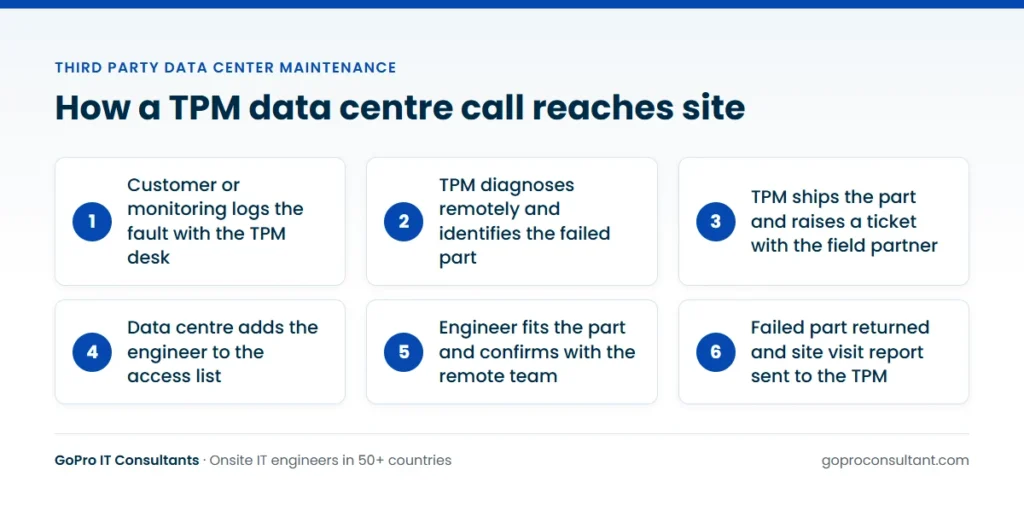
How a third party data center maintenance call flows
A well-run call looks much the same whichever vendor’s kit has failed. Typically:
- The customer or their monitoring logs a fault with the TPM’s support desk.
- The TPM diagnoses remotely and identifies the failed part, with part number and serial.
- The TPM ships the part and raises a ticket with the field partner at the right response tier.
- The data centre operator adds the engineer to the access list and confirms where the part will land.
- The engineer attends, fits the part and confirms the result with the TPM’s remote team.
- The failed part is packed for return, and a site visit report goes back to the TPM.
Steps 3 and 4 are where calls stall. If the ticket to the field partner doesn’t carry the cabinet, U position, serial number and access reference, the engineer spends the first part of the visit finding things out. We go into what a good ticket looks like in our post on scoping a smart hands support ticket.
A worked scenario: a failed storage controller in a colocation cage
Say a TPM vendor supports a customer’s storage array, which sits out of warranty in a colocation cage in another country. At 14:00 the array reports that one of its two controllers has failed. The array is still serving data through the surviving controller, but it has no redundancy until the failed one is replaced.
At the TPM’s desk
The TPM’s engineer reads the array logs, confirms the controller as the failed part and checks which firmware the surviving controller runs, because the replacement will need to match. A controller is shipped from the nearest stocking location to the facility’s goods-in under the customer’s account reference. The TPM raises a ticket with its field partner at the tier in the contract, with the cage and cabinet number, U position, array and controller serials, and the time the part is due.
At the facility
The customer, who holds the account with the colocation provider, adds the engineer to the access list. The engineer collects the part from goods-in, signs for it and is escorted or badged into the cage according to the facility’s rules. Before touching the array, they join a call with the TPM’s remote engineer and confirm the failed controller by its serial and fault light, not just by its slot.
The remote engineer prepares the array for the swap, the field engineer replaces the controller following the vendor’s procedure, and the remote engineer confirms it has come online at the right firmware and that redundancy is restored. The failed controller is packed in the replacement’s packaging and booked out through the facility’s outbound process.
Afterwards
The TPM receives a site visit report with the serials in and out, photos of the array and labels, the times of each step and the return tracking number. It passes the outcome to the customer under its own name. The customer never needs to know a field partner was involved, and nothing in the report suggests one was. The steps for the swap itself are the same as any onsite part replacement, which we cover in our post on hardware break-fix part swaps.
Parts: who ships, who holds, who returns
In most TPM set-ups, parts are the TPM’s responsibility and the engineer’s job is to fit them. That division keeps things clean, but it has to be written down. Agree in advance:
- Who ships the part to site, and whether it goes to the data centre’s goods-in or with the engineer.
- Under which account or reference the facility will hold and release it.
- How the failed part is packed, labelled and collected.
- What happens if the part is wrong, damaged or doesn’t fix the fault.
On that last point, the cleanest rule is that the engineer records what was found and what’s needed, with photos and serial numbers, and the return visit is raised as a new ticket. That gives the TPM clear evidence for the vendor or depot, and stops a single ticket stretching across days with no clear owner.
Who does what across the TPM, operator, customer and field partner
Four parties touch a data centre call, and each controls something the others need. Writing the split down once, per facility, saves a lot of phone calls on the day.
| Party | Owns | Needs from the others |
|---|---|---|
| TPM vendor | Contract with the customer, diagnosis, parts, remote support, customer updates | Fault reports from the customer, an engineer from the field partner, access from the operator |
| Customer | The equipment, the account with the facility, approval of downtime | A diagnosis and plan from the TPM |
| Data centre operator | Access, escorts, goods-in, facility rules | Access requests from the account holder, engineer ID details |
| Field partner | A screened, briefed engineer at the agreed tier, the onsite work, the report | A complete ticket, the part on site, a remote contact at the TPM |
The detail that catches people out is access. In colocation, it’s usually the customer who holds the account with the facility, not the TPM. So the access request has to come from, or be authorised by, the customer, even though the TPM is the one dispatching. Agree who raises it and how far in advance, facility by facility.
Working under the TPM’s brand
The end customer bought a contract from the TPM, not from the field partner. So the engineer should attend as part of the TPM’s team. In practice that means the TPM’s name on the ticket and badge, the TPM’s report template, and no conversation about commercial terms with the customer. Questions about the contract go back to the TPM’s account manager.
That’s how GoPro IT Consultants engineers work on white-label jobs. Our guide to white-label field services covers the set-up, and the white-label IT services page lists what we deliver under a partner’s name.
Data centre access across several countries
A TPM contract covering facilities in several countries inherits each facility’s own rules. Some want engineer names and ID numbers a set time before arrival, some need a photo ID that matches the booking exactly, and some require a site induction on the first visit. Goods-in may keep shorter hours than the data hall, which matters when a part lands late in the day. Record all of this per facility in a site sheet the field partner can see, rather than relying on whoever raised the last ticket remembering it.
Time zones add another layer. If the TPM’s desk is in one country and the facility in another, agree that the response tier runs in the facility’s local time, and that public holidays are those of the facility’s country. Planned work often has to fit the customer’s change window, which may be at night or at a weekend, so book it as a scheduled visit for that window. Check the field partner’s country coverage against every facility on the contract before you sell a tier there.
Where TPM contracts and onsite reality drift apart
A TPM contract can be well written and still fail at the cabinet. The gaps tend to be the same few.
Sites added without checking cover
Customers add facilities mid-contract, and the new site inherits the existing response tier by default. Before it goes on the schedule, confirm the field partner can meet that tier at the new address and that spares can reach it in time.
Older kit with thin spares
Much TPM work is on equipment past its OEM support dates, which is exactly why customers buy it. Spares for older models may be held centrally rather than locally. That’s fine if the tier reflects it. It’s a problem if the contract promises a fast response the parts can’t keep up with.
Treating remote hands as engineering
Facilities commonly sell remote hands services for simple tasks such as power cycles and visual checks. They’re useful, but they aren’t a substitute for an engineer who can swap a controller under direction and document it. Our guide to smart hands vs remote hands sets out where the line usually sits.
Access raised per ticket
If every visit starts with a fresh access request, the response clock is partly in the facility’s hands. Where the facility allows it, pre-register a small pool of named engineers for each site so a fault call doesn’t wait on paperwork.
Reviewing the onsite layer each quarter
Per-ticket evidence is the site visit report. Over a quarter, the useful view is the pattern behind those reports. Sit down with the field partner and go through the response achieved against the tier at each facility, the visits that couldn’t be completed and why, any parts that arrived wrong or late, and how quickly reports came back. Look for repeat faults on the same asset, which may mean a part keeps failing or the original diagnosis was off.
The review is also where the commercial shape should change. A facility generating steady weekly work may be better served by a resident engineer on agreed hours than by per-ticket visits. A facility that has gone quiet can move to a slower tier. The aim is a contract that matches what actually happens on the floor.
What data centre operators should ask
If you run a data centre and your tenants or your own estate rely on a TPM, you’re the one letting its engineers onto the floor. It’s reasonable to ask the TPM how the onsite layer works before the first fault:
- Who will actually attend, and are they the TPM’s staff or a field partner’s engineers?
- How are engineers screened for skills, identity and right to work?
- What happens if the assigned engineer can’t attend at short notice?
- What insurance covers the work on your floor?
- What report do you receive after each visit, and how quickly?
Good answers are specific. For reference, our engineers are screened for skills, identity, right to work and references, and briefed before each job. If an engineer can’t attend, a backup is assigned and the partner is told straight away. We carry public liability and professional indemnity insurance, and each visit produces a site visit report within 24 hours.
Setting up the onsite layer before the first fault
The onsite layer is easiest to arrange when a new contract is signed, not when the first PSU fails. Share the site list, the response tier at each site and the access process for each facility with your field partner. Agree the ticket format and the report template. Then run one pilot ticket, ideally a planned swap, to prove the process end to end.
Our data centre support page covers the onsite tasks we take on for TPM vendors, from hardware swaps to rack and stack and cabling. If you’re comparing partners across several countries, how third party IT maintenance providers staff onsite work looks at the sourcing side in more detail.
Frequently asked questions
Can a TPM vendor use different field partners in different countries?
Yes, many do. The risk is inconsistent tickets and reports, so it helps to agree one ticket format and one report template across every partner.
Who holds the spare parts in a TPM arrangement?
Usually the TPM vendor or its logistics provider. The field engineer collects the part on site, fits it and records the serial numbers going in and coming out.
Does the field engineer talk to the end customer?
Only about the work on site. On white-label jobs the engineer attends under the TPM's brand and passes any commercial questions back to the TPM.
How is onsite support for a TPM contract usually priced?
Commonly per ticket or by day rate, and it varies by country and response tier. Resident engineers on a monthly basis suit large estates with steady volumes.
Need onsite engineers behind your TPM contract?
Our engineer network covers 50+ countries and works under your brand. Start with one pilot ticket, no minimum commitment.
Talk to us