

A break fix contract between an MSP or TPM vendor and its field partner has one job above all others: to say, without room for argument, who turns up when a fault is logged, how quickly, and what they’re allowed to do once they’re on site. Rates, reports, parts and liability all hang off that answer.
This post covers the terms worth writing down with a field engineering partner, from the response SLA to parts handling and reporting. If you’re still deciding whether break-fix suits the service at all, read our explainer on the break-fix support model first. Here we assume you’ve made that call and need the paperwork to match.
What a break fix contract with a field partner should cover
Your contract with the end client already defines the service. The back-to-back agreement with your field partner has to support those commitments without promising things the partner can’t deliver in a given city. A common mistake is copying the end-client SLA straight across, then finding the partner only offers next business day in half the locations on the site list.
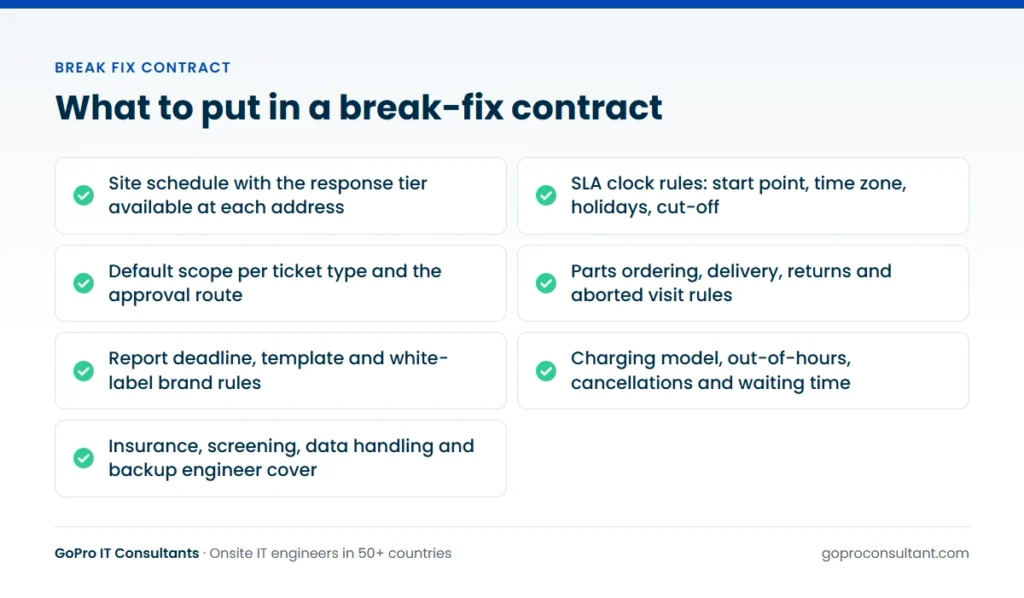
At minimum, the agreement needs sections on:
- Coverage: countries, cities and site addresses, held as a schedule rather than in the main body
- Response tiers per location, and how the clock is measured
- Scope of work for each ticket type, and the approval route when scope changes
- Parts handling, returns and what happens when a second visit is needed
- Reporting format, deadline and brand rules
- Commercial model, and the events that trigger extra charges
- Insurance, engineer screening, confidentiality and data handling
- Start, change and exit terms
Keep the site list as a schedule because sites change. You don’t want a formal amendment every time a store opens or a branch closes. A simple clause that lets either side update the schedule by email, with the partner confirming the tier available at each new address, saves weeks of admin over the life of the agreement.
Response tiers and how the SLA clock runs
Write the SLA around response, not resolution. The partner can commit to an engineer arriving within a window. Whether the fault is fixed on that visit depends on the part, the fault itself and your remote team. Putting a fix time into a field contract usually ends in arguments about whose fault the delay was.
| Tier | What it usually means | Where it fits |
|---|---|---|
| 4-hour response | Engineer on site within four hours, in covered major cities | Critical kit, tills during trading hours |
| Same business day | On site the same day if logged before the agreed cut-off | Faults that can wait a few hours |
| Next business day | On site the next working day | Most desktop, printer and peripheral faults |
| Scheduled visit | Agreed date and time, including nights and weekends | Planned swaps and change windows |
| Resident engineer | On site for agreed hours each week | Busy sites with steady ticket volume |
Then pin down the details that cause disputes. Does the clock start when the ticket is logged, or when the partner accepts it? Which time zone applies, and which public holidays in each country? What is the cut-off for same-day work? Does “on site” mean arriving at reception or reaching the kit? If an engineer waits at a security desk because nobody added them to the visitor list, that time shouldn’t count against the partner. Say so in the contract.
Scope of work for each ticket type
The engineer is there to do what the ticket says. Define the default tasks for each ticket type: diagnose, reseat, swap a part, test, and capture evidence. Then list what needs fresh approval, such as reimaging beyond a standard build, configuration changes, work on kit that isn’t on the ticket, or moving equipment between rooms.
Name the approval route. When the end client asks the engineer to “just have a look” at another machine, the engineer calls your service desk or NOC, not the client’s office manager. Agree a time-on-site allowance per ticket too, and what happens when the job runs past it. Usually the engineer phones in, you approve or stop the work, and the decision goes in the report.
What every ticket should carry
Put the minimum ticket content in the contract, so a thin ticket can be sent back before anyone travels: site address and contact, access instructions, asset make, model and serial, fault description, remote diagnostics already done, parts shipped with tracking, the expected task and an escalation number.

Parts, logistics and return visits
In most field partner arrangements, parts are shipped by you or your hardware vendor. The contract should say who orders the part, where it’s delivered (site or engineer), who confirms it has arrived before dispatch, and how faulty parts go back. For the workflow itself, see our post on how onsite hardware part swaps work.
Agree in writing that if a fix needs another part or a second visit, the engineer records what was found and what’s needed, and the return visit is raised as a new ticket. Then define an aborted visit. If the engineer travels and the part hasn’t arrived, or the site is shut, is that chargeable? There’s no right answer, but there must be an agreed one.
Reporting, evidence and white-label terms
Set a report deadline and a format. We send a site visit report within 24 hours of every visit, with photos, serial numbers, work done and anything outstanding. If you want your own template used, attach it to the contract so there’s no debate about which fields are mandatory.
If the work is white-label, spell out the brand rules: whose badge the engineer wears, how they introduce themselves, and that they never discuss commercial terms with the end client. Our page on white-label IT services covers how that usually works day to day. Also state who talks to the end client about scheduling and outcomes. Normally that’s you, not the partner.
Roles and responsibilities to write into the agreement
A field agreement is between two parties, but the work depends on a third: the end client, who controls the site. The contract can’t bind the end client, but it can say which of you is responsible for getting what’s needed from them. A short responsibility table in a schedule settles most “whose job was that” questions before they start.
| Task | MSP or TPM vendor | Field partner | End client (arranged by you) |
|---|---|---|---|
| Remote diagnosis and the part decision | Owns it | Feeds back what the engineer sees | Reports the fault |
| Ordering and shipping parts | Owns it, or its vendor does | Confirms the part has arrived before dispatch | Receives and holds the parcel |
| Site access and visitor lists | Requests it | Supplies engineer names and ID details | Grants access and names a contact |
| Doing the work in the ticket | Approves any scope change | Owns it | Makes the kit available |
| Backup engineer if one can’t attend | Is told straight away | Owns it | Not involved |
| Site visit report | Reviews and shares it | Sends it within the agreed deadline | Signs off on site where needed |
| Customer updates | Owns them | Doesn’t contact the customer directly | Receives them from you |
Adjust the cells to your own service, but keep the principle. Each task has one owner, and the contract names them.
Commercial terms that cause the most disputes
Field partners usually price per ticket, by day rate, or as a monthly FTE for resident engineers, and the figure depends on country and response tier. If the end client buys break fix maintenance from you per incident, a per-ticket model with the partner keeps your margin easy to see. Whatever the model, define these items clearly:
- What a ticket includes: time on site, travel, and any local expenses
- Out-of-hours and weekend work, and how it’s booked
- Cancellation notice, and what happens inside that window
- Waiting time caused by site access problems
- Several tickets at the same site on the same day
- Invoice timing, payment terms and how disputed lines are handled
The more of this is settled in advance, the fewer invoice queries you’ll handle each month. Our break-fix field support page sets out how we structure these engagements.
A worked example: three clauses tested by one bad morning
Say a store’s till PC fails at 06:30 and your service desk logs a 4-hour ticket at 06:45. The partner accepts it at 07:05 and an engineer reaches the store at 10:20. The shutters are down because the manager is late, so the engineer waits outside until 10:50. Inside, the replacement PC is in the stockroom, but it’s the wrong model and has no licence for the till software.
The clock clause. If the contract says the clock starts at acceptance and stops on arrival at the site, the engineer arrived inside four hours whichever start point you use. If it only says “within four hours”, you now have a debate about whether 10:20 or 10:50 counts.
The waiting time clause. The half hour outside was caused by site access, not the partner. A clear clause says whether that time is chargeable and whether it pauses the SLA. Without one, it gets argued line by line on the invoice.
The return visit clause. The wrong part means the fault can’t be fixed today. The engineer records the model shipped, the model needed and the state the till was left in, and you raise the return visit as a new ticket once the right PC is on site. Whether the first visit is charged in full depends on what you agreed for visits that can’t be completed for reasons outside the partner’s control.
None of this is unusual. The point of the contract is that each of these moments already has an answer, so the service manager can deal with the store instead of reading the agreement.
Insurance, screening, data and backup cover
Ask for public liability and professional indemnity insurance, and check the certificates rather than taking a line in the contract on trust. Ask how engineers are screened. Ours are checked for skills, identity, right to work and references, and briefed before each job. If your clients care about information security, ask whether the partner holds ISO/IEC 27001 certification, and how failed drives and other data-bearing parts are handled when they leave site.
Finally, make engineer no-shows an explicit obligation. If the assigned engineer can’t attend, a backup should be assigned and you should be told straight away, not when the client rings to ask where everyone is. Check the partner’s country coverage against your site schedule before you sign, so backup cover actually exists where you need it.
Clauses that often get left out
Most templates handle SLAs and charging. These are the clauses that tend to be missing until someone needs them.
Onward subcontracting
Field partners often work with engineers who aren’t direct employees. That’s normal, but you should know about it. Say whether the partner may use subcontracted engineers, and require that the same screening, insurance and confidentiality terms apply to them.
Site safety and inductions
Some sites need risk assessments and method statements before work starts, or an induction that takes longer than the job. State who prepares the paperwork, how much notice the partner needs, and whether induction time is chargeable.
Tools and consumables
Agree what the engineer brings as standard (hand tools, a laptop, console cables, a label printer) and what you supply, such as patch leads, cable ties or a specific diagnostic tool. Network tickets in particular depend on the right console cable, as we cover in our post on network break-fix visits.
Non-solicitation in both directions
A sensible clause stops the partner approaching your end clients and stops you hiring the partner’s engineers directly for an agreed period. It protects both businesses and is easier to agree at the start than after a dispute.
Data protection and exit
Engineers see personal data on screens and devices, so include data processing terms that match your role and the end client’s. Then plan the exit: how open tickets are finished, how reports and photos are handed over, and how long the partner keeps them.
Running one agreement across several countries
A single agreement can cover many countries, but the schedule has to carry the local detail. Set the SLA clock in the site’s local time, not your head office’s. List public holidays per country, and note where the working week differs, as it does in parts of the Gulf. Agree the language of the site visit report and whether the engineer needs to speak the local language with site staff, the reporting language, or both.
Building rules vary too. Some offices and shopping centres only allow contractor work outside trading hours, so the realistic tier there is a scheduled visit, not a same-day one. Record that against the address rather than discovering it on the first ticket. Where a busy site has steady volume in one country, a resident engineer on a monthly FTE can sit in the same agreement as per-ticket cover elsewhere.
Questions to ask a field partner before you sign
- Which response tier can you offer at each address on our site schedule, and where can’t you?
- When does your SLA clock start, and what stops or pauses it?
- Will engineers be your employees or subcontractors, and how are both screened?
- What happens if the assigned engineer can’t attend, and when will we hear about it?
- Can you use our report template, and what’s your report deadline?
- How do you charge for aborted visits, waiting time and out-of-hours work?
- Which insurance certificates and security certifications can you show us?
- Can we start with a pilot ticket before signing the full agreement?
Ask for written answers. They make a good first draft of the schedules, and any vague answer shows you where the contract needs the most care.
Test the terms on real tickets before you lock them in
Contracts drafted in a meeting room rarely survive the first month of real faults intact. Run a pilot ticket or two before you finalise the terms, look at what the report showed, and adjust the cut-offs, scope wording and abort rules to match what you learned. Add a review clause so both sides revisit the schedule every quarter. A break fix contract that gets reviewed tends to stay useful. One that’s filed and forgotten tends to be quoted only when something has already gone wrong.
That’s how we prefer to start with new partners: one pilot ticket, no minimum commitment, then terms shaped by what the first visits show. Our field engineer dispatch page lists the response tiers we offer, and you can send us your site schedule to check which tier applies at each address.
Frequently asked questions
Should a field partner contract include a fix time?
Usually not. A field partner can commit to an engineer arriving within a response window, but whether the fault is fixed depends on parts, the fault and your remote team.
Who should supply parts under a break-fix agreement?
In most arrangements the MSP, TPM vendor or hardware vendor ships the parts. The contract should say who orders them, where they're delivered and how faulty parts are returned.
Can the engineer work under our brand?
Yes, if the contract allows it. Engineers can wear your badge, use your report template and avoid any commercial discussion with the end client.
How long should the initial contract term be?
Many partners start with a pilot ticket and no minimum commitment, then move to a rolling agreement with a quarterly review once the terms have been tested on real work.
Want to test the terms on a real ticket?
Start with one pilot ticket, no minimum commitment, and get a site visit report within 24 hours with photos and serials.
Request a pilot