

The break-fix support model is the simplest way to pay for IT support: something breaks, someone fixes it, and you pay for that fix. No monthly retainer and no promise to watch over systems in between. It’s older than managed services and gets written off as outdated, yet plenty of MSPs still use it every week, often without calling it that.
This post explains how break-fix works in practice, where it fits next to a managed service contract, and why so many MSPs buy break-fix field work from someone else even when they sell managed services themselves.
What the break-fix support model actually means
In a break-fix model, support is reactive and paid per incident. A fault is reported, a technician diagnoses and repairs it, and the customer is billed for the time, the visit or the ticket. The definition is simple, but it hides three separate decisions that are worth pulling apart:
- When work happens: only after something has failed, not on a schedule.
- How it’s paid: per ticket, per hour or per visit, not as a flat monthly fee.
- Who carries the risk: the customer does. A bad month means a bigger bill.
That last point is why break-fix fell out of favour with end users. Nobody likes a surprise invoice after a server dies. But the model never went away. It moved up a level, into how IT companies buy field work from each other.
Break-fix vs managed services
The two models aren’t opposites so much as different answers to “who pays when things go wrong”.
| Break-fix | Managed services | |
|---|---|---|
| Billing | Per incident, hour or visit | Fixed monthly fee |
| Focus | Repair after failure | Prevention, monitoring and repair |
| Cost predictability | Low for the customer | High for the customer |
| Who absorbs a bad month | The customer | The provider |
| Typical use today | Onsite hardware faults, ad hoc jobs, subcontracted field work | End-user IT, servers, networks, security |
Here’s the part that’s easy to miss. A managed service still needs break-fix underneath it. When a monitored switch fails in a branch 300 miles from your nearest engineer, the remote monitoring tells you it’s down, but someone still has to go and swap it. The customer pays you a flat fee; you pay for that visit as a one-off. Your contract with the customer is managed. Your arrangement with whoever drives to the site is break-fix.
Why MSPs buy break-fix field work
Very few MSPs can justify their own engineers in every town where they have a client. A few sites in Manchester, one in Glasgow and a handful in Germany don’t add up to full-time roles anywhere. So they buy onsite visits per ticket from a field partner. The reasons are practical:
- Cost follows demand. You pay for a visit when a client needs one, not for an engineer sitting idle between faults.
- Coverage without hiring. You can take on a client with sites in a new region or country without recruiting there first.
- Response tiers per ticket. A down core switch can go out on a fast response; a faulty desk phone can wait for next business day.
- Your brand stays in front. A good partner’s engineer turns up as part of your team, so your client sees one supplier.
Our break-fix service works exactly this way for MSPs, TPM vendors and integrators. One ticket, one engineer on site, and a report back within 24 hours.
Hybrid arrangements between the two models
Few service contracts are pure break-fix or purely managed. Most sit somewhere in between, and knowing the common variants helps you decide what to sell to customers and what to buy from partners.
Block hours or prepaid tickets
The customer buys a bank of hours or visits up front and draws them down as faults happen. It keeps the reactive feel of break-fix but gives the customer a budget figure and gives you some cash flow. The weak point is the edges. Decide what happens to unused hours at the end of the term, and what happens when the bank runs dry in a busy month, before the customer asks.
Managed remotely, break-fix onsite
This is where most MSPs with spread-out estates end up. Monitoring, patching, the service desk and security sit inside the monthly fee. Onsite attendance is either included up to a limit or billed per visit. Your margin depends on how well you predict that onsite element, so look at the fault history for each site before you fix the fee, not after the first bad quarter.
Resident cover where the volume justifies it
When one site keeps generating tickets, paying per visit stops making sense. A resident engineer on agreed hours turns a stream of break-fix calls into a fixed monthly cost, and the engineer gets to know the site well enough to catch small problems before they become tickets. A common pattern is resident cover at the head office or the busiest sites, with break-fix everywhere else.
How a break-fix ticket runs from start to finish
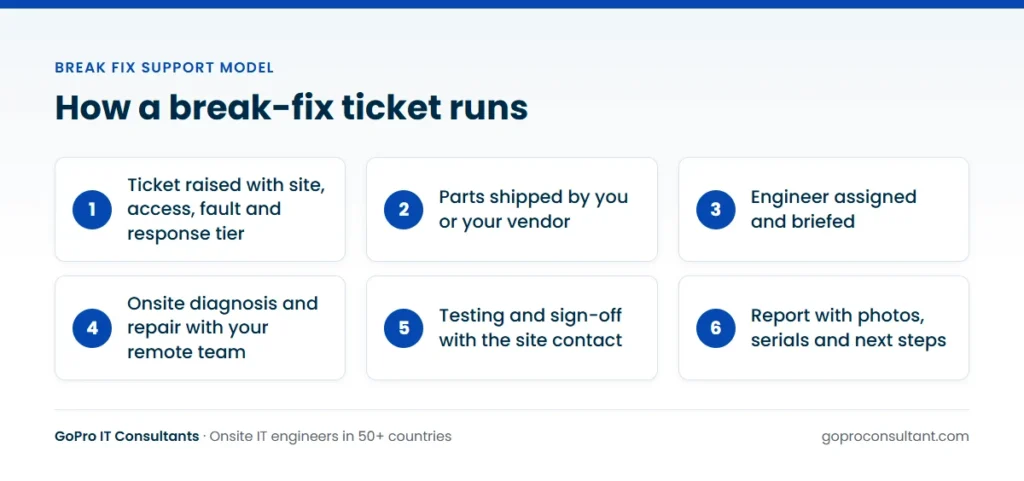
Whatever the fault, a well-run break-fix job follows the same shape:
- Ticket raised with the site address, contact, access details, the fault and the response tier.
- Parts shipped by you or your hardware vendor, if the fix needs them.
- Engineer assigned and briefed before travelling.
- Onsite diagnosis and repair, often with your remote team on the phone or Teams.
- Testing and sign-off with the site contact.
- Report with photos, serial numbers, work done and anything outstanding.
Not every fault clears in one visit. If the engineer finds the problem needs a different part, the right move is to record exactly what was found, confirm what’s needed, and book the return visit as a new ticket. Guessing on site wastes everyone’s time. We go into parts, serials and dead-on-arrival returns in our post on hardware break-fix.
A worked scenario: one failed switch, two ways of paying for it
Say you look after a retailer with forty stores across the UK and a handful in Germany. At ten on a Saturday morning, an access switch fails in a store two hours from your nearest engineer. The tills and the store Wi-Fi hang off that switch, so the store is trading on card machines with their own SIMs and not much else.
If the customer pays you per incident
The store manager rings your service desk. You triage remotely, confirm the switch isn’t responding and that nothing upstream has failed. You explain what an onsite visit involves and what each response tier means. Because the customer pays per incident, they make the call: the fastest tier today, or a next business day visit on Monday. You raise the ticket with your field partner, ship a replacement switch, and bill the customer for the visit and the part once the report comes back.
If the customer is on a managed contract
Your monitoring flagged the switch before anyone in the store noticed. The tier isn’t up for discussion, because the contract already sets the response you owe. You raise the same ticket with the same field partner, ship the same part, and the engineer does the same work. The difference is who pays: the visit comes out of your monthly fee instead of going on a customer invoice.
Notice what stayed the same. The ticket, the part, the engineer and the report are identical in both versions. The commercial model sits on top of the field work, not inside it. That’s why the quality of your break-fix arrangement with a field partner matters even if every customer contract you sign is managed. A slow or careless visit costs a break-fix customer money, and costs a managed provider its margin and some goodwill.
How break-fix field work is usually priced
When you buy break-fix visits from a field partner, you’ll normally see one of three ways of charging. Most partners mix them depending on the job.
- Per ticket. A set charge for a visit with an agreed amount of time on site. It’s simple to quote back to your client, and it works well for routine faults such as a failed desktop, a dead access point or a printer that won’t talk to the network.
- Hourly after a minimum. Better for faults where nobody knows yet how long the diagnosis will take. Check whether travel counts and how part hours are rounded.
- Day rate. Useful when several faults at one site, or a fault plus some installation work, can be grouped into a single visit.
Whichever applies, the response tier you pick for each ticket matters more than the model. A 4-hour response in a city centre costs more than a scheduled visit next Tuesday, so pick the tier per ticket rather than per contract wherever you can.
Choosing a model site by site
You don’t have to choose once for a whole customer or a whole country. It works better site by site, using four plain questions: how often does this site need someone on site, how critical is the kit there, how far is it from anyone you employ, and how predictable are its faults.
| Situation | What usually fits | Why |
|---|---|---|
| Remote branch with a few faults a year | Break-fix per ticket | No fixed cost through long quiet spells |
| Critical site with rare but serious faults | Break-fix on a fast response tier | You pay for speed only when it’s needed |
| Busy head office with tickets most days | Resident engineer | Steady volume suits a monthly FTE |
| Planned swaps, moves and upgrades | Scheduled visits | Booked into a quiet window, including nights and weekends |
| New region with unknown volume | Break-fix, reviewed after a quarter | Real ticket data before you commit to anything fixed |
Review the split every quarter. Pull the onsite tickets by site, the tier used for each, and whether the fault was cleared on the first visit. A site that has crept from occasional to weekly visits is a candidate for resident cover. A site that has gone quiet can drop back to per-ticket. The model should follow the ticket data, not the way the contract was first drawn up.
Where the break-fix model goes wrong
Break-fix gets its bad reputation from a few avoidable problems, and each one has a simple fix.
No agreed response times
“We’ll send someone” isn’t a commitment. Agree the tiers up front, by location, and agree what counts as arrival. Without that, every slow visit turns into an argument about what was promised.
Unclear charging
Know whether you pay per ticket, per hour or per day, and what happens if a job overruns or needs a second visit. Ask how travel is treated and whether a visit cancelled at short notice is charged. Surprises on the partner’s invoice tend to become surprises on your customer’s.
Poor handover
If the engineer leaves without a written report, you can’t prove the work to your client, reconcile parts or learn from the fault. Insist on a report for every visit, with photos and serial numbers, even for a five-minute reseat.
Everything treated as urgent
Paying for the fastest tier on every ticket is the quickest way to make break-fix expensive. Set a rule at your service desk for which faults justify a 4-hour response, and name who can approve an exception.
Thin tickets
A ticket that says “PC not working” sends an engineer out blind. They arrive without the right part, the right access or any idea what your remote team already tried. Put the asset details, the fault, the diagnostics done and the access instructions in every ticket, and let the partner send back any ticket that’s missing them.
Most of this comes down to the paperwork you agree before the first job. We cover what belongs in that agreement in what to include in a break-fix contract.
Is break-fix right for you?
For your own clients, it depends on the size and spread of what you look after. For your field coverage, break-fix is often the sensible default. You keep fixed costs down in places where faults are occasional, and you can still offer a fast onsite response when it matters.
A good test is to look at where your engineers spent the last quarter. If a lot of hours went on driving to sites outside your core area for one-off faults, those visits are good candidates for a break-fix partner. You can also try it with a single ticket before committing. We dispatch field engineers in 50+ countries, on 4-hour response in major cities, same business day or next business day, and engineers can attend under your brand.
Every engineer is screened for skills, identity, right to work and references, and briefed before the job. You can price work per ticket, by day rate, or as a monthly FTE for resident cover, depending on the country and tier. Check our global coverage against your site list, then send one pilot ticket with no minimum commitment and judge the model on a real fault.
Frequently asked questions
Is break-fix support cheaper than managed services?
Not automatically. It's cheaper when faults are rare and sites are spread out, and more expensive when a lot of urgent visits stack up. Many MSPs sell managed services and buy break-fix field work underneath.
What happens if a break-fix visit can't fix the fault?
The engineer records what was found and what is needed, and the return visit is booked as a new ticket once the right part is on site.
Can break-fix engineers work under my company's name?
Yes, if your partner offers white-label work. The engineer introduces themselves as part of your team and reports in your format.
How quickly can a break-fix engineer get to a site?
It depends on the response tier you choose per ticket: 4-hour response in major cities, same business day if logged before the cut-off, next business day, or a scheduled visit.
Need an engineer at a site you can't reach?
Send one break-fix ticket. We dispatch in 50+ countries and report back within 24 hours with photos and serials.
Send a ticket