

Smart hands services put a skilled technician inside a data centre or server room to do physical work you can’t do remotely: racking a new server, swapping a failed disk, re-patching a switch, or tracing a cable that someone labelled wrong three years ago. The engineer works to your instructions, but unlike basic remote hands, they can think on their feet when the job doesn’t go to plan.
If you run infrastructure for clients in several cities, you’ll book this kind of work more often than you’d expect. Here’s what smart hands normally cover, what they don’t, and how the billing tends to work, so you know what you’re paying for before you raise the ticket.
What smart hands services usually include
Most smart hands work falls into a handful of task types. The exact list varies by provider, but these are the ones you’ll see on almost every scope:
- Rack and stack. Unboxing, mounting rails, racking servers, storage and network kit, and connecting power and data to a plan you supply.
- Hardware swaps. Replacing disks, power supplies, fans, memory, line cards and optics, usually with parts your vendor ships to site.
- Cabling and patching. Running, re-patching and labelling copper and fibre within the rack or between cabinets.
- Console and diagnostic work. Plugging in a console cable or crash cart so your remote team can see what the box is doing, then following their steps.
- Audits and photos. Recording serial numbers, checking cabling against documentation, and photographing racks front and back.
- Decommissioning. De-racking old equipment, packing it for return, or preparing it for secure disposal.
What ties these together is judgement. A remote hands technician will reboot a server because you asked. A smart hands engineer will notice the second PSU is already amber and tell you before you lose the box completely. If you want the full comparison, we’ve written about smart hands vs remote hands vs a field engineer separately.
What usually sits outside a smart hands scope
Knowing the edges saves arguments later. Smart hands engineers normally don’t:
- design your network or decide what the fix should be (they carry out the plan, your engineers own it),
- supply the replacement parts (those come from you or your hardware vendor),
- log in and make configuration changes unless you’ve explicitly asked and given access,
- take responsibility for kit outside the agreed rack, cage or room.
Work outside a data centre, say a failed switch in a branch office or a till that won’t boot in a store, is normally booked as a field engineer visit rather than smart hands. The skills overlap, but the logistics are different: travel, site access, opening hours and a named person on site to sign the job off.
How smart hands services are billed
There isn’t one standard price model, but nearly every provider uses some mix of the following.
Per ticket or per task
A fixed charge for a defined job, such as one disk swap or one server racked. It’s easy to budget and easy to pass on to your own client. The catch is that the definition has to be tight. If “rack one server” quietly turns into “rack one server, re-cable the switch and move two others”, expect a second line on the invoice.
Hourly, with a minimum first period
Common for diagnostic work where nobody knows how long it will take. You pay a minimum for the first block of time, then by the hour or part hour after that. Ask how time is measured: from arrival on site, from the moment the engineer starts work, or from dispatch.
Day rate
Better value for project work such as a full rack build or a migration weekend. You book an engineer for the day and fill it with tasks.
Response tier
Whatever the model, how fast you need someone moves the price more than anything else. A 4-hour response in a major city costs more than next business day, and a scheduled visit booked a week ahead usually costs least.
| Billing model | Works best for | Watch out for |
|---|---|---|
| Per ticket | Repeatable, well-defined tasks | Scope creep on the day |
| Hourly with minimum | Faults where the cause is unknown | How time is counted |
| Day rate | Rack builds, migrations, audits | Idle time if the site isn’t ready |
| Monthly or retained | Regular weekly work at one site | Paying for hours you don’t use |
We price our own smart hands and data centre support per ticket or by day rate, depending on the country and the response tier, which is typical of independent providers.
A worked example: one rack refresh, billed three ways
Say your client is replacing four ageing 1U servers in a single rack in a third-party facility. The new servers are already in goods-in. The job is to de-rack the old four, rack the new four on the rails supplied, connect each to the A and B power feeds, patch two data cables per server to the top-of-rack switch, label everything to the client’s convention, photograph the rack front and back, and pack the old servers for collection.
Billed per task
You’d raise it as four de-racks, four installs and a patching task. That looks tidy on a purchase order and maps neatly onto what you charge your client. The weak spot is anything the task definitions don’t mention. If one set of rails doesn’t fit the cabinet depth, or the switch ports in the plan are already in use, each fix becomes a variation, and variations need approving while the engineer waits.
Billed by the hour
Hourly billing on a job this predictable moves all the risk to you. Twenty minutes at the security desk, a goods-in team that can’t find the boxes or a remote contact who’s in another call all land on the invoice. Hourly works for faults, where nobody can say how long the diagnosis will take. It’s a poor fit for a job whose shape you already know.
Billed as a day
A day rate absorbs the small surprises. A rail swap, a re-plan of two ports and some extra labelling all fit inside the day without a new approval. The risk here is idle time: if goods-in won’t release the boxes until late morning, you pay for that morning anyway. For a planned job of several hours with the site confirmed ready, a day rate usually gives you the most predictable invoice. Per task wins when the same small job repeats across many sites, and hourly stays the right tool for diagnosis.
One more line belongs in the scope for this kind of job: what happens to the old servers. If they’re going for secure disposal rather than back to a leasing company, book it as part of the plan through an IT asset disposition service, so the drives don’t sit in a corner of the cage for weeks.
Defining scope in a smart hands agreement
If you book this work regularly, don’t define scope ticket by ticket. Agree a short task catalogue with your provider up front. Each entry names the task, states what’s included and what isn’t, and says which response tiers are available for it. “Rack one device up to 2U, rails supplied, power to both feeds, up to four data connections, labelled and photographed” is a usable entry. “Rack and stack” on its own isn’t, because nobody knows where it stops.
The catalogue also needs a change rule. When the engineer finds the job is bigger than the ticket, what do they do: stop and call, carry on up to a set amount of extra time, or record it for a new ticket? Name the person on your side who can approve extra work, and make sure they’re reachable during the visit. Without that, a capable engineer either stops too early or keeps going and leaves you to argue about the invoice afterwards.
Then decide the small items that cause the most friction. Who packs and labels a failed part for return, and is that part of the swap or a separate task? Does receiving a delivery count as work? Are photos and serial numbers always included, or only on request? It also helps to know what your colocation contract already covers, because some simple tasks may be included there. Our post on what colocation remote hands includes and what’s extra sets out where that line usually falls. If the work runs under your brand, add the report template and the rules for talking to the end client, which is how white-label IT services normally work.
What drives the cost up (and what keeps it down)
Two jobs that look identical on paper can cost quite differently. The usual reasons:
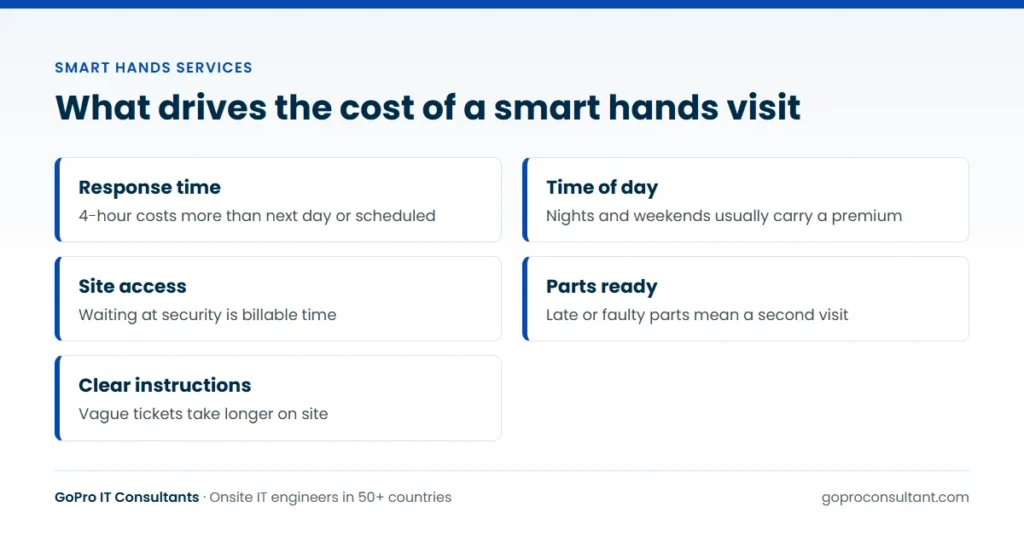
- Response time. Same-day and 4-hour work needs an engineer free at short notice.
- Out of hours. Nights and weekends usually carry a premium, though change windows often make them unavoidable.
- Access delays. If the engineer spends 40 minutes at the security desk because their name isn’t on the access list, someone pays for that time.
- Missing parts. A part that arrives late or dead on arrival turns one visit into two.
- Vague instructions. The more the engineer has to work out on the day, the longer it takes.
Most of these are in your control. A clear ticket, a confirmed access request and parts that are already on site will cut more from the bill than any rate negotiation. We’ve put together a pre-visit checklist for data centre smart hands if you want something to work from.
Billing disputes and how to avoid them
Most arguments about smart hands invoices come from a handful of situations that nobody agreed in advance. Settle them before the first ticket and they rarely come up.
Aborted visits
The engineer arrives and can’t work: the access request wasn’t approved, the part isn’t there, or the change window was cancelled. Most providers charge for an aborted visit, because the engineer’s time is gone either way. Agree what counts as aborted, and whether the charge differs when the cause sits with the provider rather than with you or the facility.
Waiting time
Time spent at security, waiting for an escort or waiting for your remote contact to confirm a step is usually billable. Ask how the engineer records it in the report, so you can see where the time went and push the cause back to the right place.
Overruns
If a job booked as a fixed task or a half day runs over, does the engineer stop at the booked time or carry on? Both answers are reasonable. What matters is that the ticket says which, and that extra time is approved by a named person rather than discovered later.
Cancellations, travel and expenses
Check how much notice you need to give to cancel or move a scheduled visit without a charge. For sites outside major cities, or work in another country, ask whether travel time, parking, tolls and overnight stays are inside the ticket price or added on. A quote that looks keen can grow quickly once a long drive is billed separately.
Scope and billing questions to settle before you book
Copy these into your onboarding notes for any new provider. If the answers come back vague, the invoices will too.
| Question | Why it matters |
|---|---|
| Which tasks are priced as fixed tasks, and what does each include? | Stops “rack one server” meaning different things to each side |
| When does billable time start and stop? | Dispatch, arrival and start of work give very different totals |
| How are aborted and cancelled visits charged? | The most common surprise on a first invoice |
| Who can approve extra work on the day? | Avoids both stalled jobs and unapproved overruns |
| Are travel and expenses included for every site on your list? | Remote sites and other countries can change the picture |
| What’s in the report, and how soon does it arrive? | You need it to bill your own client and close the ticket |
| What happens if the engineer can’t attend? | Tells you whether a backup is arranged or the visit just slips |
For our own work, the answers are short. Pricing is per ticket or by day rate, depending on country and response tier. If an engineer can’t attend, a backup is assigned and you’re told straight away. If a fix needs parts or a second visit, the engineer records what was found and what’s needed, and the return visit is a new ticket, so each visit stands on its own on the invoice.
Colocation smart hands or an independent provider?
Most colocation facilities sell their own smart hands, and for a quick task in a single site that’s often the simplest route. Their staff are already in the building and know the access process.
An independent provider starts to make more sense when:
- you have kit in several facilities run by different operators and want one process and one report format across all of them,
- the job is bigger than a quick task, such as a full rack build, a migration or an audit,
- the same work also needs doing at offices or branches, and you want one engineer pool for both,
- you need the engineer to work under your company’s name in front of your client.
We look at the cost side of that decision in more detail in our piece on Equinix smart hands cost.
What you should get back after every visit
A smart hands job isn’t finished when the engineer leaves the cage. You need proof, especially if you’re passing the work on to your own client. As a minimum, ask for:
- arrival and departure times,
- what was done, step by step, and anything that didn’t go to plan,
- serial numbers of anything removed or installed,
- photos of the rack before and after,
- anything still outstanding, with a clear next step.
We send a site visit report within 24 hours of every visit, in our format or in your own template if you’d rather your client never sees our name.
Getting started without a big commitment
If you haven’t used an outside smart hands provider before, don’t sign a long contract on day one. Send one real ticket, see how fast someone turns up, how well they follow your instructions and what the report looks like. That tells you more than any sales call. We cover data centres and server rooms through our engineer network in 50+ countries, and the first job is a normal ticket with no minimum commitment.
Frequently asked questions
Can smart hands engineers work under our company name?
Yes. Many providers, including us, can send engineers who introduce themselves as part of your team and report in your own template, so your client sees one supplier.
Who supplies the replacement parts for a smart hands job?
Normally you or your hardware vendor ship the parts to the site. The engineer fits them, records the serial numbers and packs the failed part for return.
How quickly can a smart hands engineer get to site?
It depends on the city and the tier you book. In major cities a 4-hour response is common; elsewhere same business day or next business day is more realistic.
Do we pay if the engineer arrives and can't start work?
Usually yes, because the engineer's time is used either way. Agree in advance what counts as an aborted visit and whether the charge depends on who caused it.
Need smart hands in another city?
We send skilled engineers to data centres and server rooms in 50+ countries, on 4-hour, same day or next business day response.
Book smart hands