

POS system installation cost across a store estate comes down to a handful of things: how many lanes each store has, how much kit goes on each counter, when the work has to happen, where the stores are, and how much can go wrong on the night. The hardware price is usually fixed by the time you ask for a quote. The installation is where the variation sits.
This post walks through the drivers one by one, so you can write a scope that gets a comparable quote from any installer, and spot where a low number is hiding a gap.
What actually drives POS system installation cost
Most installers price retail work per store visit, per day or per ticket. Whatever the model, the number is built from engineer time on site, travel, and the risk that the job overruns. Everything below feeds one of those three.
| Driver | Why it moves the price |
|---|---|
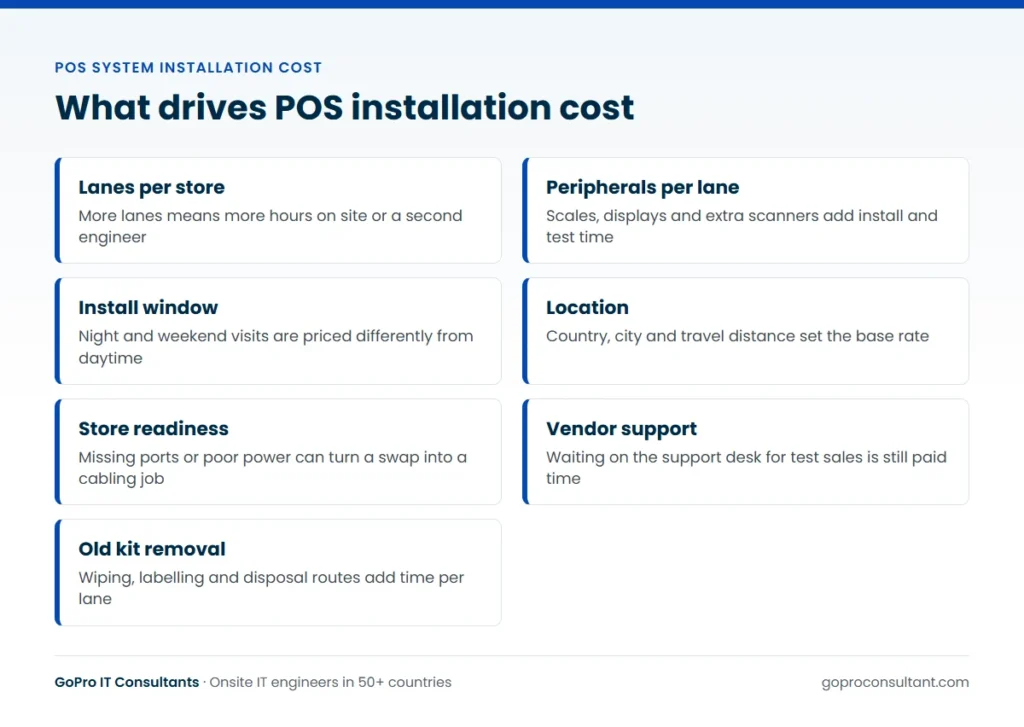
| Lanes per store | More lanes means more hours on site, and possibly a second engineer |
| Peripherals per lane | Scales, customer displays and second scanners all add install and test time |
| Install window | Night, early-morning and weekend visits are priced differently from weekday daytime |
| Location | Country, city and travel distance set the base rate |
| Store readiness | Missing ports, poor power or no cabinet access turns a swap into a small cabling job |
| Vendor dependency | Time waiting on a support desk for test transactions is still engineer time |
| Old kit removal | Data wiping, labelling and disposal paperwork take time and need a route out |
Store size and kit per lane
A convenience store with two tills and a hypermarket with thirty are different jobs, even with identical hardware. Lane count is the first thing any installer will ask for, and it’s worth giving them the real number per store rather than an estate average. Averages hide the large sites, and the large sites are where overruns happen.
Then list what goes on each counter. A basic lane might be a terminal, receipt printer, cash drawer and card reader. Add a flatbed scanner-scale, a customer-facing display, a second handheld scanner or a cash recycler and the time per lane goes up. Self-checkout units, kiosks and back-office PCs are separate line items, so call them out.
Timing: nights, early mornings and store hours
Most retailers want new tills in without losing trading hours. That usually means installing after close or before opening, which affects the price in two ways. Out-of-hours visits are typically charged differently from weekday daytime, and a fixed window caps how many lanes one engineer can finish, so a bigger store may need two engineers rather than one.
Be specific in your scope. “Out of hours” can mean 6pm to midnight or 1am to 6am. Give the actual access time, the time the store must be trading again, and whether the work can be split over two nights with one old till left running in between. A two-night plan can sometimes come out cheaper than a single night with two engineers.
Location, travel and response tier
Rates differ by country and by city. A store in a capital city with engineers nearby is a different proposition from a retail park two hours from the nearest one. For an international estate, expect the installer to price by country or region, and give them the full address list rather than a count of stores per country.
Planned rollout visits are booked on an agreed date and time, which is usually the most economical tier. Urgent follow-ups (a till that fails the morning after) sit in a faster response tier and cost more, so it’s worth agreeing up front how those will be logged and charged. Our field engineer dispatch service covers both, priced per ticket or by day rate depending on country and response tier.
Store readiness: the hidden cost
The quote assumes the store is ready. When it isn’t, the price changes or a second visit gets booked. The usual culprits:
- No spare switch ports in the comms cabinet, or a cabinet nobody has the key for.
- A dead or missing network drop to one or more lanes.
- Not enough power sockets at the counter, or tills running off extension leads.
- Kit delivered to the wrong store, or part of the delivery missing.
- Counter furniture that doesn’t fit the new terminal or mount.
A site survey or a simple photo questionnaire completed by each store manager (cabinet, counter, power, network sockets) cuts this risk a lot. If you can’t do that across the estate, at least do it for the pilot store and a sample from each store format. When a job can’t be finished, the engineer should record what was found and what’s needed, and the return visit becomes a new ticket. Ask every installer how they handle that, because it’s where budgets drift.
Testing, vendor support and old kit
Every lane needs a test sale, a refund, a drawer open and a card transaction before the store opens. That usually needs the POS vendor’s support desk on the line. If their desk is slow to answer or closes before the install window ends, the engineer is on the clock waiting. Book the vendor’s support time alongside the engineer’s visit and you take a lot of that idle time out of the quote.
Old kit is the other easy thing to leave out. Disconnecting, wiping where required, labelling with serial numbers and packing for collection all take time per lane. Then there’s where it goes. Returned to a depot, held for a courier or retired through IT asset disposition with certified recycling partners are three different scopes, and the quote should say which one it covers.
Pricing models and when each one fits
The same scope can be priced in several ways, and the model you pick changes who carries the risk of an overrun. None is cheaper by default. The right one depends on how uniform your stores are and how well you know the time per lane.
| Model | Fits best when | Watch out for |
|---|---|---|
| Fixed price per store | Store formats are similar and the pilot has measured real time per lane | What happens when a store turns out bigger or less ready than the scope said |
| Per ticket | Visits are one-off jobs: a single store, a follow-up fault, a small batch | How tickets that overrun the expected duration are handled |
| Day rate | The estate is mixed and time per store varies a lot | You carry the overrun risk, so store readiness matters even more |
| Monthly resident engineer | A dense cluster of stores needs daily cover through the rollout and hypercare | Keeping the engineer busy between waves |
Mixed models are common. A large programme might price the waves per store, the return visits per ticket and the post go-live cover through a resident engineer on agreed hours in the region with the most stores. What matters is that each model has a written definition of what’s in and what’s extra.
A worked example: three store formats
Say you’re pricing an estate with three formats: small convenience stores with two lanes, high-street stores with five or six, and a handful of large superstores with more than twenty lanes plus self-checkouts. Here’s how the drivers above play out on each.
Convenience stores
The on-site time is short, so travel becomes the biggest part of the cost. Stores are often spread across small towns, and a single store per night can mean more driving than installing. Grouping stores by area and booking two on the same evening, where the access windows allow it, usually does more for the budget than anything else. Readiness risk is low, but a single dead network drop takes out half the store’s lanes, so a quick photo check before the visit is still worth it.
High-street stores
These are the core of most estates and the format the pilot should measure. One engineer can usually finish in a night if the kit and access are right, which makes a fixed price per store realistic. The cost risk sits in variation: one store with a cabinet in a locked landlord riser, another with counters that don’t fit the new mount. Price the format, then flag the exceptions from your store survey.
Superstores
Here the install window is the constraint. Twenty-plus lanes and a bank of self-checkouts won’t fit into one engineer’s night, so the choice is two or three engineers on one night, or one engineer over several nights with part of the store trading on old tills. The second option needs more coordination with the store and more vendor support sessions. The first needs more people in the same window. Ask bidders to price both and compare them with real numbers, not instinct.
International estates: what changes the price
Across several countries, a few extra things feed the quote. Rates differ by country and by city, so a regional average is misleading. Public holidays and trading-hour norms differ too, which changes when out-of-hours windows fall. Kit shipped across borders can be held at customs, and a visit booked before the kit clears may end up as a cancelled or wasted trip. Language matters when the engineer has to work with a night manager and a vendor desk in different countries.
The fix is the same as for a single country, just stricter: a full address list, a kit-arrival gate before each visit is confirmed, and a quote broken down by country. Check where a bidder’s engineers actually are against your list; our global coverage page shows where our engineer network operates.
Mistakes that push the cost up
Most budget overruns on POS rollouts trace back to a short list of avoidable errors:
- Pricing from an estate average. The quote fits the typical store and the large stores blow it.
- Skipping the pilot. Time per lane is guessed rather than measured, and every wave inherits the guess.
- Booking visits before kit arrives. The engineer turns up to an empty stockroom and the trip is paid for anyway.
- Not booking vendor support. Engineers wait for test sales, or leave lanes untested and come back.
- Leaving return visits undefined. Nobody agreed who pays when a store wasn’t ready, so every one becomes a dispute.
- Forgetting post go-live cover. Faults in the first days get booked at the fastest response tier because nothing else was planned.
Each of these is cheaper to prevent with a line in the scope than to fix in the middle of a wave.
How to get a quote you can compare
Installers can only price what you tell them. If one quote looks much lower than the rest, it’s usually because that installer assumed less: fewer peripherals, daytime access, no disposal, or no allowance for waiting on the vendor. A clear scope fixes most of that. Send every bidder the same pack:
- Full store list with addresses, store format and lanes per store.
- Kit list per lane and any extra devices (kiosks, back-office PCs, switches).
- Install window per store, and whether work can span two nights.
- Who ships the kit, and when it arrives relative to the visit.
- The test script and the vendor support arrangements.
- What happens to old kit, and what records you need.
- Reporting format: photos, serial numbers, sign-off.
Ask each bidder to state their pricing model (per store, per ticket or day rate), what counts as a return visit, and what they need from you for a store to count as ready. A single POS installation fee per store looks tidy, but check what it includes before you compare it with a day-rate quote. Our EPOS installation and support service page sets out what we cover, and our multi-site rollout service explains how a pilot store and the waves after it are run.
For a fuller view of the on-site work you’re pricing, see POS installation services for multi-site retail rollouts, and for judging the bidders themselves, how to choose POS installation companies. The most reliable way to firm up POS system installation cost for your estate is to run one pilot store, measure the real time per lane, and price the waves from that.
Frequently asked questions
Is it cheaper to price per store or by day rate?
It depends on how uniform your stores are. Per-store pricing suits estates with similar formats, while day rates suit mixed estates where the time per store varies a lot.
Who pays if the engineer can't finish because the store wasn't ready?
That should be agreed before the rollout starts. The engineer records what was found and what's needed, and the return visit is logged as a new ticket, so the terms for those tickets belong in the contract.
Does the quote include the POS hardware?
Usually not. Hardware is normally bought and shipped by you or your vendor, and the installation quote covers engineer time, travel and the agreed scope on site.
How can I reduce the cost of a large rollout?
Give every bidder a complete scope, confirm store readiness before each visit, book vendor support for the install window and run a pilot to measure real time per lane.
Want a quote for your store estate?
Send us your store list and kit per lane. Pricing is per ticket or day rate, by country and response tier.
Request a quote