

Commercial network cable installation pricing depends on a handful of things you can mostly pin down before you ask for a quote: how many points, what cable category, what containment is needed, what the building is like to work in, when the work can happen, and how it will be tested. Two quotes for “50 data points” can be miles apart because they’re quietly assuming different answers to those questions.
We won’t give figures here, because they vary too much by country, city and site. What we can do is explain what drives the cost, so you can write a brief that gets comparable quotes and spot the gaps in the ones that come back.
What drives commercial network cable installation pricing
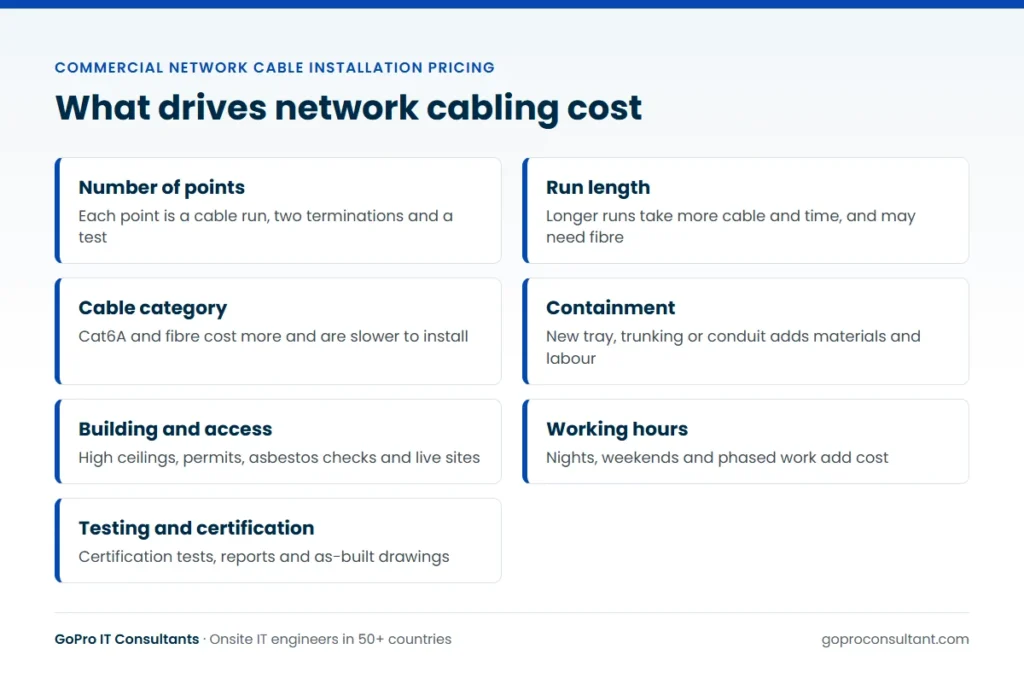
Most of the cost in a cabling job is labour. Materials matter, but time on site, the number of people and the hours they work make up the bulk of it. Anything that adds time or makes the work harder shows up in the price. Here are the main drivers in summary, each covered below.
| Cost driver | Why it moves the price |
|---|---|
| Number of points | Each point means a cable run, two terminations and a test |
| Cable category | Cat6A and fibre cost more to buy and take longer to install |
| Containment | New tray, trunking or conduit adds materials and labour |
| Building type and access | Ceiling height, asbestos checks, live sites and permits all add time |
| Working hours | Out-of-hours and weekend work usually costs more |
| Testing and certification | A full certification test and report takes time per link |
| Survey and design | A proper survey costs up front but reduces surprises later |
Number of points and run lengths
The point count is the headline number in most quotes, but run length matters just as much. A point ten metres from the comms room is a very different job from one at the far end of a long floor. Long runs use more cable, take longer to pull, and can push you close to the distance limits for copper Ethernet, which may mean an extra comms room or a fibre link.
Be clear about what a “point” means in your brief. Is a double outlet one point or two? Does it include the patch panel port and patch leads, or only the cable and faceplate? Contractors count these differently, so define it.
Also say who supplies the materials. Some buyers have a preferred cable and connectivity brand, or already hold stock from a previous project. Others expect the contractor to supply everything. Either is fine, but a quote that includes materials and one that doesn’t will look very different, and the cheaper one may simply be leaving out the cable.
Finally, think about moves and changes after the install. If you know more desks are coming, adding spare points now is usually far cheaper than bringing a contractor back later to run a few cables through a finished ceiling.
Cable category: Cat6, Cat6A and fibre
Cat6 is the common choice for general office data and phones. Cat6A supports higher speeds over the full channel length and is often specified for wireless access points and anywhere that needs headroom for the future. It’s thicker and stiffer, which means more space in containment, larger bend radii and slower installation. Fibre is usually used for backbone links between comms rooms, or for runs too long for copper.
Specify the category, and whether the system should be shielded or unshielded, in the brief. If you leave it open, one contractor will quote Cat6 and another Cat6A, and the prices won’t be comparable.
Containment, building type and access
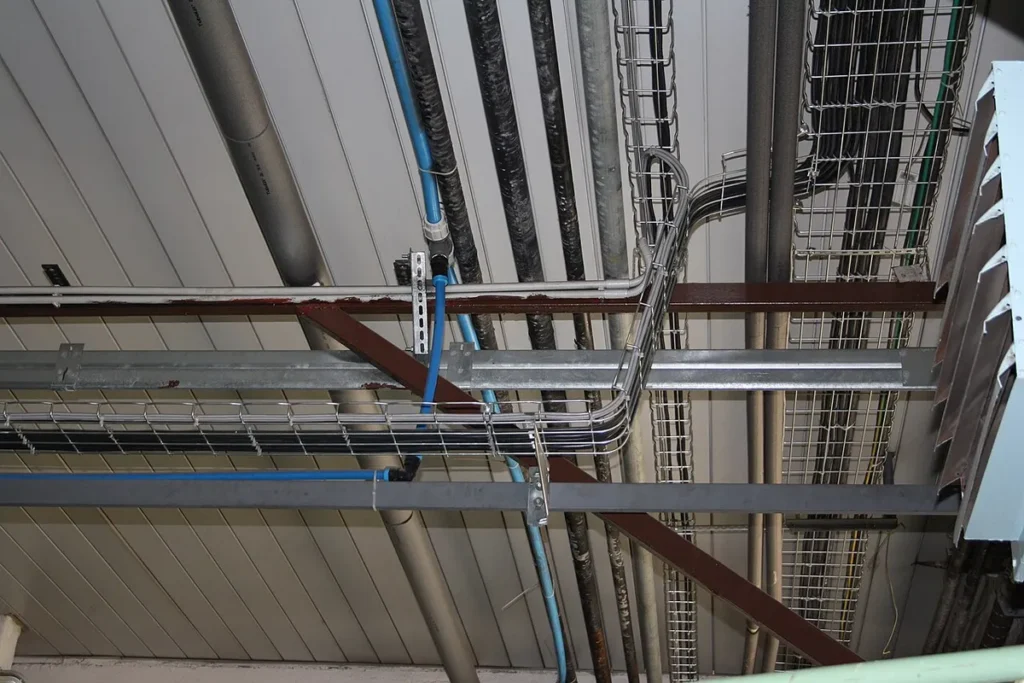
If the building already has cable tray or trunking with spare capacity, the job is far simpler. If containment has to be installed, it can become a big part of the cost. Open-plan offices with accessible ceiling voids are usually the easiest. Older buildings, solid walls, listed buildings, warehouses with high ceilings and retail units with finished ceilings are slower and may need special access equipment.
Several access questions affect the cost to install network cabling:
- Ceiling height, and whether ladders, towers or powered access are needed.
- Whether an asbestos survey is required before drilling or lifting tiles in an older building.
- Fire-stopping when cables pass through walls and floors.
- Building management rules: permits, inductions, escorts and loading bay slots.
- Whether the site is live, occupied or empty during the work.
Out-of-hours work and site constraints
In retail, hospitality and busy offices, cabling often has to happen at night or at weekends so customers and staff aren’t disrupted. That usually costs more per hour, and it can stretch a job over more visits because each shift is shorter. Ask the site what’s actually allowed before you request quotes. “Anytime” and “only after 10pm on Sundays” are very different jobs.
Also say whether the job has to be phased, for example one floor at a time while the rest stays in use. Phasing adds mobilisation and set-up time to each stage.
Testing, certification and documentation
Every new link should be tested with a cable certification tester against the category it was installed to, and you should receive the test results. A simple continuity check isn’t the same thing, and quotes that only include “testing” may mean either. Ask specifically for certification testing and a copy of the results, plus as-built drawings and a labelling schedule.
If you need a manufacturer’s system warranty, say so up front. It usually requires an accredited installer, approved components and full test results, all of which affect the price.
Extras that often turn into variations
The quote covers what the contractor expected to find. Variations cover everything else. These are the items most often left out of the original price and added later, so ask each contractor whether they’re included:
- Strip-out of old cable. Redundant cable fills containment and confuses future work. Removing it takes time, and it’s often assumed to be someone else’s job.
- Making good. Repairing ceiling tiles, filling holes and redecorating around new outlets.
- Fire-stopping. Sealing every penetration through fire walls and floors, and the evidence that it was done.
- Patch leads and cabinet work. Leads, cable management and any new cabinet or rack.
- Access equipment. Towers or powered access hired for high ceilings or warehouses.
- Waste removal. Packaging, offcuts and old cable taken off site.
- Extra outlets added on site. Points the client asks for once the team is already there, priced at whatever rate the contract says.
- Return visits. When the ceiling was closed, the room was locked or the furniture hadn’t arrived.
A quote that looks lower but excludes half of these may end up costing more. Ask for the exclusions to be listed, not implied.
Reuse, extend or recable: choosing the scope
Before pricing a full new installation, decide what the existing cabling can still do. The scope you choose has a bigger effect on cost than almost any line in the quote.
| Option | When it fits | Cost trade-off |
|---|---|---|
| Reuse existing cabling | Suitable category, good condition, passes certification testing | Lowest cost now, but only if testing confirms it |
| Extend with new points | Sound existing system, with spare panel ports and containment | Moderate cost, but mixing old and new can limit performance |
| Recable in phases | Live site that can’t close, mixed condition | Spreads cost, but adds set-up and mobilisation per phase |
| Full recable | Old category, failing links, poor or no documentation | Highest cost now, but gives a known, documented system |
If you’re not sure what’s there, pay for the existing links to be tested first. Results showing which links pass and which fail turn a guess into a scope. If wireless is changing at the same time, a wireless site survey before cabling tells you where access point cables need to go, so they’re priced in the same job rather than added later.
A worked example: three quotes for the same office
Say you send the same floor plan to three contractors for a new office fit-out and get three very different numbers back. Laid side by side, the reasons usually look like this.
The lowest quote prices Cat6, assumes the existing basket tray has space, counts a double outlet as one point and lists “testing” with no mention of certification or results. The middle quote prices Cat6A as your brief asked, includes certification and as-built drawings, but excludes patch leads and fire-stopping. The highest quote includes everything, plus new containment along one corridor where the contractor’s surveyor found the existing tray was full, and assumes evening working because the building manager told them daytime drilling isn’t allowed.
On paper the first looks best. In practice it’s pricing a different, smaller job, and the gaps would return as variations. The useful move is to send all three a revised brief that fixes the category, the point definition, the containment position, the hours and the testing, then ask them to requote. The spread usually narrows sharply, and what remains is a real difference in rates and approach you can judge.
Multi-site and multi-country cabling costs
Travel and mobilisation
Small sites spread over a wide area cost more per point than one large site, because a bigger share of the time goes on travel and set-up. Grouping nearby sites into one trip helps.
Local contractors and local rules
In each country you’ll usually use a local cabling contractor, and labour rates, permit processes and building rules differ. Keep one standard brief and one documentation format across all of them so the results are comparable.
Standardising the design
A standard design per site type (same category, labelling scheme, cabinet layout and test standard) cuts survey and design time on every site after the first. It also makes future support cheaper, because every site looks the same to the engineer who visits.
Follow-on work
Cabling is rarely the last task. Switches, access points and patching follow, and if the network is run as a service afterwards, our managed network services page covers the ongoing side. Budget for those steps alongside the cabling so the sites aren’t left cabled but not working.
How to get network cable installation pricing you can compare
The best way to get sensible network cable installation pricing is to remove the guesswork. A site survey, even a short one, lets the contractor see the containment, ceilings and comms room before pricing. Without one, quotes either carry a margin for unknowns or come back later with variations. If you have no one local, an engineer booked through our site surveys page can visit on an agreed date and record photos, measurements and access details for you to send to contractors.
Then write a brief that covers:
- A floor plan with every outlet marked and the comms room location.
- The cable category, outlet type and patch panel requirements.
- Who supplies containment, and whether it’s new or existing.
- Allowed working hours and any access rules.
- Testing, certification and documentation required.
- The target completion date and whether it can be phased.
For multi-site jobs, run one site as a pilot before committing to the rest. It shows how long a typical site really takes and what the hidden issues are. Our multi-site rollout service uses that pilot-then-waves approach. For smaller jobs alongside cabling, such as patching, cabinet work or switch installs, field engineer dispatch covers the on-site hands. We price per ticket, by day rate or monthly, depending on country and response tier.
Questions to ask a cabling contractor before you accept a quote
Copy these into your quote request, or ask them before you sign:
- How do you define a point, and what does each point include?
- Which cable and connectivity brands are you pricing, and is a manufacturer warranty included?
- Did you survey the site, or is this priced from drawings only?
- What have you assumed about containment, and what happens if it’s full?
- Is certification testing included, and will we receive the full results?
- Are fire-stopping, strip-out, making good and waste removal included?
- What working hours have you priced, and how are out-of-hours shifts charged?
- How are variations priced and approved?
- What documentation do we get at handover, and in what format?
If voice is part of the same job, our post on voice and data cabling covers what changes in the brief.
For what happens once the job is approved, see structured cabling installation step by step.
Frequently asked questions
Is it cheaper to reuse existing cabling?
Sometimes. If the existing cable is a suitable category, in good condition and passes certification testing, reusing it can save work. Old or untested cable often costs more in faults later.
Should a cabling quote include patch leads and patch panels?
It should say clearly either way. Ask each contractor to list what is included, so you're not comparing a full installation with a cable-only price.
Why do quotes vary so much for the same number of points?
Usually because contractors are making different assumptions about cable category, containment, access, working hours and testing. A detailed brief and a site survey narrow that gap.
Can cabling be done while the office is in use?
Often yes, but it may need to be phased or done out of hours to limit disruption. Tell contractors what's allowed so they can price it properly.
Want a survey before you price cabling?
An engineer can visit and record photos, measurements and access details for your cabling brief. Start with one pilot ticket.
Book a site survey